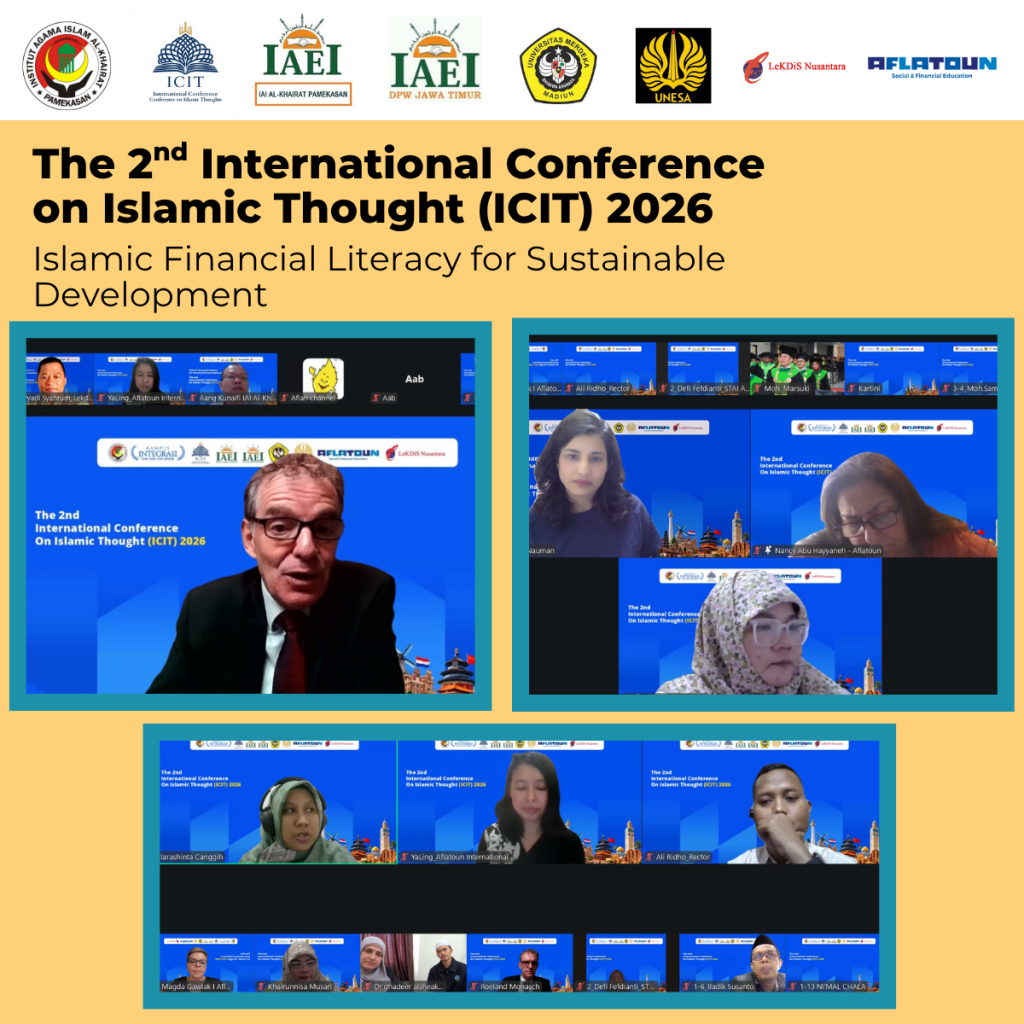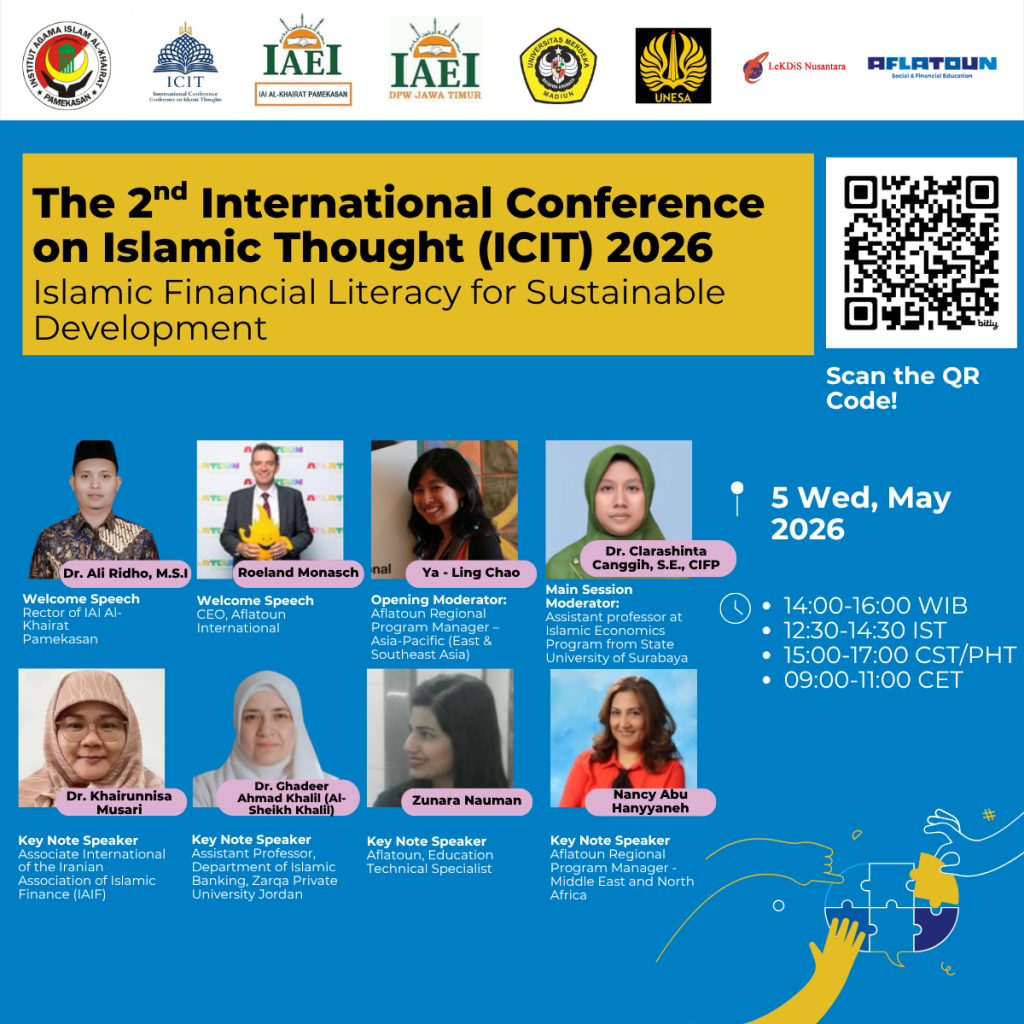







The 2nd International Conference on Islamic Thought (ICIT) 2026 brought together a global learning community to discuss one timely question: how can Islamic financial literacy help young people make better choices and support sustainable development?
The online conference welcomed 264 participants from eight countries: Bangladesh, Indonesia, Jordan, Laos, Malaysia, Mongolia, the Netherlands and Pakistan. Participants joined from universities, Islamic institutes, civil society organisations, microfinance institutions and the wider Aflatoun network.
Co-hosted by Aflatoun International, Al-Khairat Islamic Institute Indonesia and Lekdis Nusantara Indonesia, the event created space for educators, researchers and practitioners to explore how values-based financial education can prepare young people for a fast-changing financial world.
Opening the session, Roeland Monasch, Chief Executive Officer of Aflatoun International, reminded participants that financial literacy is about more than money. He described it as a path to social empowerment, helping children and young people gain the confidence and agency to shape their own lives.
He also highlighted why financial education must be inclusive. For many young people in Muslim communities, financial inclusion is not only about access to banks, savings or digital tools. It is also about whether those tools align with their values.
This is why Aflatoun is developing a specialised Islamic finance supplement. The supplement will build on Aflatoun’s existing curricula and work as a practical add-on to current social and financial education programmes. It will be shaped with academics, regional experts and partners to make sure it is both technically sound and useful for learners.
Dr. Ali Ridho, Rector of Al-Khairat Islamic Institute, also emphasised the role of Islamic educational institutions in strengthening financial literacy. He noted that Islamic finance is not only a field of study, but a practical system rooted in justice, transparency and social welfare.
The expert panel was moderated by Dr. Clarashinta Canggih Septianasari and brought together speakers from Jordan, Indonesia and the Aflatoun International team.
Dr. Ghadeer Ahmad Khalil, an academic in Islamic banking from Jordan, opened the panel by explaining the core principles of Islamic finance. These include the prohibition of interest, risk and profit sharing, clarity in contracts and a strong connection to the real economy.
She noted that Islamic finance does not deal only with “paper numbers”. Instead, financing should be linked to real assets, real value and real growth. For young people, she argued, Islamic financial literacy can support responsible decision-making, especially as they navigate digital finance, online platforms and new financial products.
Dr. Ghadeer also stressed that accessibility matters. It is not enough for a product to be halal. It must also be simple, clear and easy for young people to use. Digital tools, including open banking, smart contracts, blockchain and artificial intelligence, can help make Islamic finance more accessible, if they are guided by strong ethical principles.
From Indonesia, Dr. Khairunnisa Musari explored the relationship between development and sustainability. She pointed to a difficult paradox: in many countries, higher human development can come with a higher ecological footprint. In simple terms, progress can sometimes place greater pressure on the planet.
Her presentation suggested that Islamic financial literacy could help shape more sustainable patterns of consumption and production. By linking financial decisions to ethics, public interest and care for the environment, Islamic finance can become part of a wider conversation on sustainable development.
Nancy Abu Hayyaneh, Aflatoun’s Regional Programme Manager for the Middle East and North Africa, addressed a common misconception: Islamic finance is not only for Muslims. She explained that its core values, including fairness, transparency, risk sharing and social responsibility, can speak to wider global audiences.
She also raised a practical challenge: language. Many Islamic finance terms come from Arabic, and their meaning can be lost or confused when translated. For example, words linked to interest, risk or contracts need careful explanation, especially when teaching children and young people.
Nancy argued that the way forward requires clear terminology, capacity building and integration into education systems. Her key message was simple: language enables inclusion, capacity enables application, and education enables sustainability.
The final presentation came from Zunara Nauman, Education Technical Specialist at Aflatoun International. She brought the discussion close to young people’s everyday lives.
She shared examples of the confusion many young people face when they hear messages such as “double your savings”, “daily profits”, “buy now, pay later”, “zero percent down payment” or “instant microloan approved”. These phrases are common in today’s digital economy, but many young people do not know how to judge whether they are financially safe or aligned with their values.
Zunara also shared youth voices from Indonesia. One student asked how to save money safely in a Sharia-compliant way. Another wondered whether a savings account with fixed interest should be avoided. A university student raised questions about bitcoin, fintech apps and whether fast returns are real investment or speculation.
For Zunara, these questions show why young people need more than general advice. They need practical guidance that helps them understand financial products, compare options and make informed choices.
She explained that Aflatoun’s proposed Islamic finance supplement will not replace existing financial literacy curricula. Instead, it will work as a plug-in. It can be added to lessons on savings, investment, entrepreneurship, digital finance and money management.
The supplement will focus on three areas: foundational Islamic finance principles, practical financial tools and decision-making exercises. This means learners will not simply be told what to do. They will be supported to understand the options available, assess risks and make choices that fit their context and values.
The discussion also touched on artificial intelligence, online gambling, e-commerce, crypto, digital platforms and changing job markets. Across these topics, one message came through clearly: financial literacy must keep pace with the real world young people are living in.
The conference closed with reflections on the role of Islamic education in building financial knowledge that is not only theoretical, but practical. Speakers agreed that Islamic financial literacy should help young people understand money, protect themselves from harm, explore opportunities and contribute to society.
ICIT 2026 showed that financial education is not just about saving, spending or investing. It is about confidence. It is about values. And for many young people, it is about finding a clear path through a financial world that can feel exciting, confusing and risky all at once.
The message from the conference was clear: young people need financial education that speaks to their realities, respects their values and prepares them to shape a more just and sustainable future.
Watch the full conference here.