

From conversations about financial education and impact measurement to wellbeing, youth leadership and community organising, August with Aflatoun 2026 created a global space for people to learn from one another.
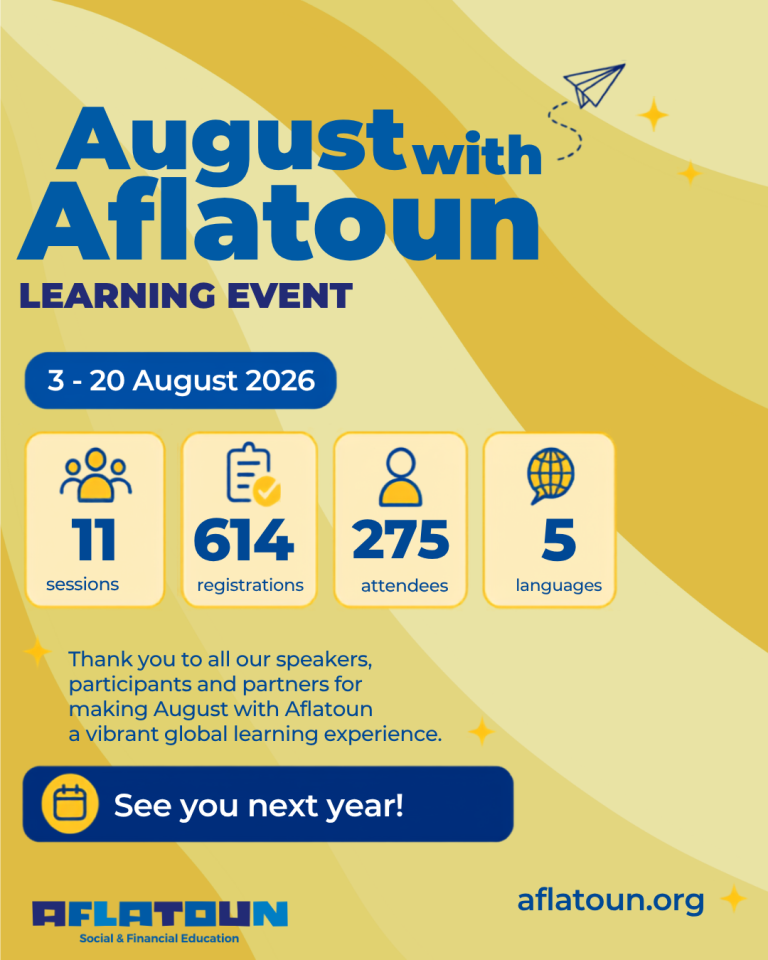
Held virtually from 3–20 August 2026, the learning event brought together educators, practitioners, partners and professionals from across Aflatoun’s wider network and beyond.
Across the event, 11 sessions generated 614 registrations and 275 live attendances, with learning offered in Arabic, English, French, Russian and Spanish.
The numbers tell only part of the story. What made August with Aflatoun valuable was the range of perspectives shared and the willingness of speakers and participants to move beyond presentations into reflection, discussion and practical exchange.
Learning from different perspectives
The programme explored how social and financial education connects with many of the challenges educators, organisations and young people encounter today.
Carl Manlan invited participants to look closer to home with The Original Family Business. His English and French sessions explored families as early spaces for learning about budgeting, negotiation, leadership, risk and resilience — recognising that valuable financial skills often develop long before formal business education.
Financial understanding was also explored from another angle by Julieta Caminetsky. Her Spanish-language workshop examined functional literacy in financial education: the difference between being able to read financial information and truly understanding a contract, financial news story or loan conditions. Participants worked through practical examples and considered how educators can help close this gap.
Michael Gilmore, co-founder of the Money Awareness and Inclusion Awards, focused on another essential question: how do we know whether our programmes are making a difference? In Measure Twice, Cut Once, he explored why meaningful impact measurement begins by understanding where organisations and the people they serve are starting from — not only where they finish.
Putting people at the centre
Several sessions challenged participants to rethink the environments we create for learning, work and personal development.
In To Be (Seen) in the Space, José Antonio Otoya Nieto used experiences around attention deficit hyperactivity disorder and neurodiversity to explore how relationships and trust can shape a learner’s ability to identify and communicate their own needs. His sessions encouraged participants to shift from simply designing for learners towards designing with them.
Nikia Brown and Mikaela Frechette, PhD, meanwhile, explored personal wellbeing through Reclaiming Your Energy in a Culture of Burnout. Participants reflected on energy, purpose, balance and boundaries, applying design-thinking approaches to their own lives and work.
And in The Inner Child Advantage, Fabio Montagna drew on the idea of the “inner child” to explore the value of curiosity. His session challenged participants to keep asking “why”, focus on genuine human needs and resist becoming overly focused on outputs and metrics at the expense of meaningful value.
From relationships to collective action
Learning also extended beyond individual practice to how people build communities, partnerships and opportunities.
Juliet Giorgadze reframed networking as something much deeper than collecting contacts. Through Networking with Purpose, participants explored how authentic relationships can develop into collaborations, partnerships, professional opportunities and funding.
In Arabic, Alaa Jarad of Ruwwad Al Tanmeya introduced participants to community organising and campaign practices, including participatory leadership and approaches that place communities themselves at the centre of collective action.
And Lia Bayramova explored how environmental action and green skills can provide pathways for young people who are not in education, employment or training to rebuild confidence, strengthen practical skills and reconnect with their communities.
Together, these conversations demonstrated the breadth of learning that contributes to social and financial empowerment: from understanding money and measuring change to strengthening relationships, wellbeing, leadership and participation.
Thank you to our speakers
August with Aflatoun would not have been possible without the speakers who generously shared their experience, ideas and time.
A heartfelt thank you to Alaa Jarad, Carl Manlan, Fabio Montagna, José Antonio Otoya Nieto, Julieta Caminetsky, Juliet Giorgadze, Lia Bayramova, Michael Gilmore, Mikaela Frechette, PhD, and Nikia Brown, as well as to everyone who supported, facilitated and participated in the sessions.
Most importantly, thank you to the hundreds of people who registered, joined live, asked questions and shared their own experiences. The event was designed as a learning exchange, and the participation of the wider community is what brought it to life.
See you next year
August with Aflatoun may be over for 2026, but the conversations continue.
We look forward to building on what we learned and bringing the community together again for another August with Aflatoun.
See you next year!
August 28, 2026